If you run an interior design studio and spend more time chasing suppliers than designing, you have probably considered whether someone else could handle procurement for you. The answer is yes, but the “someone else” varies enormously, and choosing the wrong model can cost you more than doing it yourself.
The interior design industry trained you to design spaces, to think about light and materiality and how people move through a room, and then it buried you in spreadsheets, supplier emails, and delivery tracking. Procurement can consume up to 250 hours per residential project, and almost none of that work is creative. It is operational, repetitive, and it is the reason most studio principals feel more like project coordinators than designers.
This guide covers every model available for handling procurement, from brand representatives who cost you nothing but only carry their own brands, to full-service agencies that charge 10–20% of your FF&E budget, to in-house hires, to procurement platforms that automate the operational layer entirely. Each model serves a different studio size, project type, and budget, and each comes with trade-offs that are rarely explained clearly.
Key takeaways
- • Procurement agents handle the non-creative operational work of sourcing, ordering, and delivering FF&E so you can focus on design.
- • Five main models: brand reps, independent agencies, OS&E specialists, in-house managers, and procurement platforms.
- • Brand reps are paid by manufacturers (7–15% commission) and cost you nothing directly, but only represent their own brands and prioritise high-volume accounts.
- • Agencies charge 10–20% of FF&E value or 30–50% markup, handling everything from sourcing through installation.
- • OS&E procurement is a separate discipline from FF&E, most relevant to hospitality and superyacht projects, covering operational supplies like linen, tableware, galley equipment, uniforms, and housekeeping equipment.
- • In-house managers become cost-effective at £500k+ annual FF&E spend, with UK salaries of £22,000–£78,000.
- • Procurement platforms like Procurist automate sourcing, FF&E schedules, and supplier coordination for boutique studios of 3–15 people without agency fees or a full-time hire.
- • The right model depends on your studio size, project type, procurement volume, and whether you need specialist expertise or ongoing capacity.
What is a procurement agent in interior design?
A procurement agent is any external professional, internal team member, or technology platform that manages the operational side of sourcing, purchasing, and delivering furniture, fixtures, and equipment for interior design projects. The role exists because procurement, which can consume 40–60% of a studio’s working hours, is operational work that generates no creative value but determines whether a project is delivered on time, on budget, and to specification.
If you have ever spent an entire morning requesting quotes from four suppliers for a single dining table, copying specifications into a spreadsheet, chasing a manufacturer in Italy for a lead time update, and then updating your FF&E schedule manually because a client changed their mind about a finish, you already understand why this role exists. The question is not whether you need help with procurement, it is which type of help actually fits your studio.
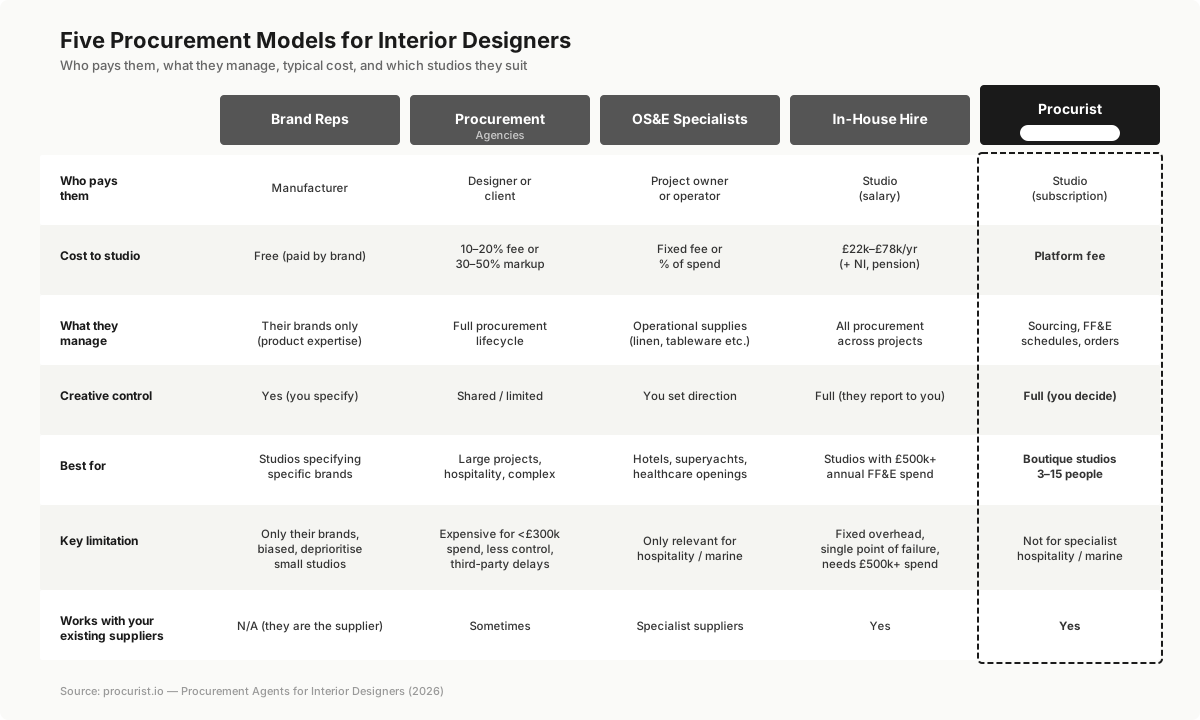
The five main models are:
- • Brand representatives and regional agents who work on behalf of manufacturers and are paid by the brands they represent, not by you
- • Independent procurement agencies who manage the entire procurement lifecycle, from specification through to installation, and charge you or your client directly
- • OS&E procurement specialists who handle operational supplies and equipment (distinct from FF&E), primarily in hospitality and superyacht projects
- • In-house procurement managers employed full-time by a design studio to manage procurement across all projects
- • Procurement platforms that automate the operational layer of procurement through software, handling sourcing, scheduling, and supplier coordination without requiring an external person or agency fee
Each model serves a different purpose, operates on a different cost structure, and suits a different studio profile. The sections below explain how each one works in practice, what they cost, and when they make sense.
Brand representatives and regional agents
Brand representatives are sales professionals appointed by furniture, lighting, or materials manufacturers to promote and sell their products within a defined territory. They are paid by the brand, not by you, which makes them the only procurement model that costs the studio nothing directly, though that does not mean their services come without trade-offs.
How brand reps work and who they represent
There are two distinct models within this category, and the difference matters for how you interact with them.
Direct reps work on a manufacturer’s payroll. They are common with large commercial furniture companies (Steelcase, MillerKnoll, Haworth) and fabric houses. They represent a single brand exclusively, and their job is part product specialist, part salesperson, part specification consultant. You will encounter direct reps most often at trade shows, CPD events, and showroom appointments, and they tend to have the deepest technical knowledge of their product range because it is all they do.
Independent reps own their own businesses, employ their own staff, and typically represent multiple non-competing manufacturers across a geographic territory. This is the dominant model in the premium furniture and lighting sector across the UK and Europe. An independent rep might carry an Italian furniture line, a French lighting brand, and a Scandinavian accessories range, carefully curated to avoid direct competition between the brands in their portfolio. Their knowledge is broader but necessarily less deep than a direct rep’s, and their loyalties are split across multiple principals.
In both cases, the rep’s core job is to get their brands specified on your projects. They do this by visiting your studio to present new collections, hosting showroom appointments and CPD sessions, providing samples, finish swatches, and mock-ups, assisting with space planning and product selection, facilitating custom configurations and bespoke orders, coordinating with the manufacturer on pricing, lead times, and technical specifications, and shepherding orders through production and delivery.
The distinction between an agent and a distributor is also important. An agent solicits orders on behalf of the manufacturer, and the manufacturer ships and invoices directly. A distributor buys stock from the manufacturer, holds inventory in their own warehouse, and resells it. Some companies, like Notable Group in the UK, operate as both, holding stock of their Scandinavian and European brands in a Shropshire warehouse while also taking bespoke orders that ship directly from the factory. The practical difference for you is that distributors can often deliver faster (from UK stock) but may carry a narrower selection of finishes and configurations than the full factory range.
How brand reps interact with you day to day
The relationship between a designer and a brand rep, when it works well, is consultative rather than transactional. A good rep does not just take orders, they become part of your extended project team for the products they carry.
In practice, this means a rep will visit your studio to present new products or specific solutions for a project you have briefed them on, provide product data sheets, CAD files, and specification information in whatever format your studio uses, arrange for samples and finish swatches to be sent (particularly valuable when the manufacturer is based overseas and obtaining samples independently would take weeks), advise on custom options that may not appear in the standard catalogue, give you realistic lead times based on current factory capacity rather than the optimistic estimates often published online, prepare pricing proposals that reflect your trade discount, and handle order queries and delivery coordination once a purchase is placed.
The flip side is that this consultative service is available primarily to studios that specify their brands with some regularity. If you are a two-person practice specifying one sofa a year from their Italian manufacturer, you are unlikely to receive the same level of attention as a mid-sized hospitality studio placing quarterly orders. This is the commercial reality of a commission-based model, and it is one of the reasons smaller studios often find themselves underserved by the traditional rep system.
How brand reps make money
Brand reps earn commission from the manufacturer, typically 7–15% of net sales. The rate varies by product category, order volume, and the complexity of the sales cycle.
Residential and boutique furniture and lighting reps tend toward the higher end of the range (10–15%) because order volumes are smaller, the selling process is more consultative, and specification often requires multiple studio visits, sampling rounds, and custom configuration support. Commercial and contract furniture reps, dealing in larger volumes with more standardised products, tend toward the lower end (5–10%). Some agreements include a base commission plus volume bonuses, for example 5% on delivered sales with a 1% bonus when monthly deliveries exceed a specific threshold.
You pay nothing for the rep’s services directly. The cost of the rep’s commission is built into the manufacturer’s pricing structure, which means the trade price you receive already accounts for the rep’s cut.
Territory and exclusivity
Premium European brands entering the UK market almost always appoint a single exclusive agent or distributor for the UK and Ireland. The agent is expected to develop the market over time by building relationships with key design practices, getting products specified on projects, attending trade shows (Clerkenwell Design Week, Decorex, the London Design Festival), and sometimes maintaining a showroom presence.
Exclusivity agreements typically specify territory boundaries, product lines covered, commission rates, minimum sales targets, reporting obligations, and termination terms. If the agent fails to meet minimum thresholds, the brand can terminate exclusivity or appoint additional reps.
For you, territory restrictions have a practical implication: if you are working on projects across multiple countries, you may need to deal with different reps for the same brand in different territories. A sofa you specified through your UK rep cannot simply be ordered through the same person for your project in Milan, you will need to work with the brand’s Italian agent, who may have different pricing, different terms, and a different level of responsiveness.
Which studios and projects suit brand reps best
Brand reps are most valuable to studios that repeatedly specify products from a focused portfolio of manufacturers, because the relationship deepens with each project and the rep’s understanding of your design language, budget sensitivities, and client expectations improves over time. They are particularly useful for studios that specify high-end European brands only available in the UK through their appointed agent, for practices working on residential projects where the consultative support around sampling, finish matching, and custom configuration adds genuine value, and for lighting-focused projects where specification is technical and a specialist rep can advise on dimming compatibility, beam angles, and regulatory compliance alongside aesthetics.
Brand reps are less useful when you need to source across many manufacturers simultaneously (the rep only carries their own brands), when you need project-wide procurement management rather than product-specific support, or when your projects require products from categories the rep does not cover.
Real examples in the UK
Several established agencies represent premium European brands to UK interior designers:
- • Hudson Evans Agencies represents brands including DCWéditions (French lighting) and Ceccotti Collezioni (Italian furniture), with over 20 years in the specification market and a trained Interior Architect on their team
- • Barry Perrin Lighting and Interiors represents Fabbian, Martinelli Luce, Sagax, and Slide Design, with 40+ years specialising in the specification market for interior designers and lighting designers
- • Notable Group distributes Scandinavian and European brands including Umage and Halo Design from their Shropshire warehouse and London showroom at the Business Design Centre
- • Viaduct in Clerkenwell acts as the official UK and Ireland agent for e15 (German), Emeco, and Mattiazzi, operating as a showroom-based agent and retailer hybrid
- • Interior Marketing has been representing European furniture brands to UK designers since the early 1990s
- • Litmus Furniture operates a 10-person field sales team covering England, Scotland, Wales, and Ireland, representing furniture brands to 400+ retail customers and design practices
Pros and cons
What works well: No direct cost to you. Deep product expertise that would take hours to research independently. Access to exclusive European brands that are only available through their appointed rep. Sampling support, finish swatches, and mock-ups from overseas manufacturers. A good rep becomes a long-term resource who proactively brings relevant products to your attention.
What does not work well: Reps only promote the brands they represent, which creates an inherent bias. Small studios lack the spending power to be prioritised. Adding a layer between you and the manufacturer can slow information, particularly around pricing and lead times, and designers consistently cite unresponsive vendors as a top frustration. Territory restrictions add complexity on international projects. The multi-layer distribution chain makes it genuinely difficult to understand your actual margin.
What brand reps do not solve
Here is what brand reps leave untouched: your procurement workflow. A rep can help you specify and order a beautiful Italian dining table, but you are still building the FF&E schedule in Excel, still manually tracking which items have been ordered and which are outstanding, still copying product data between supplier websites and your own documents, still coordinating deliveries from fifteen different suppliers across three countries. The product expertise problem is solved, the operational problem is not.
This is one of the reasons Procurist was built to work alongside brand reps rather than replace them. The rep handles product expertise and manufacturer relationships, Procurist handles the operational workflow: sourcing, FF&E schedule generation, order tracking, and supplier coordination inside one system. You get the benefit of the rep’s knowledge without the spreadsheet infrastructure that normally surrounds it.
Independent procurement agencies
Independent procurement agencies manage the entire lifecycle of furnishing a project, from specification through to installation and handover. Unlike brand reps who work for manufacturers, procurement agencies work for you or your client, and unlike brand reps who promote a specific portfolio, agencies source from any supplier that meets the project brief. They charge for this service, and the cost is not insignificant, but for the right project type and studio profile, they carry a workload that would otherwise consume your creative capacity entirely.
What they actually do
The phrase “procurement agency” undersells what these firms do. The service extends far beyond placing purchase orders, and understanding the full scope is essential before you can evaluate whether the fee is justified for your studio.
Specification and design coordination is where the engagement begins. The agency collaborates with your design team to agree the general aesthetic and performance requirements of the FF&E scheme, refining specifications through workshops and sampling rounds. They detail suppliers, products, fabrics, and finishes for client sign-off, and critically, they categorise FF&E items by project phase to align procurement with the construction schedule, so items are not ordered too early (requiring expensive warehousing) or too late (causing installation delays). Be-Studio specifically phases FF&E items against construction milestones and room-by-room completion sequences.
Sourcing and purchasing is the most visible part. Established agencies maintain relationships with 50+ suppliers across 13+ countries (as TEN London explicitly states), giving them access to manufacturers, artisans, and specialist workshops that most individual studios would never discover or be able to order from independently. They negotiate trade pricing, bulk discounts, and payment terms, and create cost-saving alternatives when budgets are exceeded without compromising the design intent. For bespoke items, the agency manages the technical specification process, coordinates with the maker, and oversees production quality.
Budget and financial management runs throughout. The agency builds detailed project budgets, tracks actual spend against approved amounts for every line item, processes payments to suppliers, and provides regular financial reporting to you and your client. In the UK, when acting as agent, BIID guidance requires client funds to be held in separate accounts.
Order management and logistics is where agencies earn a substantial part of their fee. Monitoring lead times across dozens of suppliers, some manufacturing in Italy, others in Portugal, others in Scandinavia, each with different production cycles, holiday closures, and shipping routes, is a full-time coordination exercise. The agency manages international shipping and customs clearance (including post-Brexit documentation), arranges cargo insurance, coordinates warehousing, consolidates shipments, and plans the transport sequence from factory to warehouse to site.
Quality control happens at multiple stages. Good agencies inspect items at the factory, upon receipt at the warehouse, and again before delivery to site. OCCA Design runs a 9-step procurement process with inspection points built in at each stage.
Installation coordination is the final phase: planning on-site installation sequences, coordinating with contractors, positioning items, snagging, and managing handover. Some agencies like Dragonfly Contracts in Manchester maintain their own installation teams.
Some agencies also operate on a white-label basis, working invisibly under your studio’s brand so the client sees one integrated service.
Project types and specialisations
Most procurement agencies have a primary specialism, and the logistics, compliance requirements, and supplier networks differ substantially across sectors.
Hospitality is the largest sector. FF&E on a new hotel project typically accounts for 8–15% of total construction budget, with per-room budgets ranging from approximately £3,200–£5,600 for a 2-star property to £28,000+ for 5-star luxury. A single hotel opening can involve thousands of line items, strict brand standard compliance, and installation sequences aligned with a fixed opening date.
High-end residential involves luxury homes, townhouses, and penthouses where FF&E budgets can range from £100,000 to several million. The complexity here comes from the bespoke nature of items, the number of specialist suppliers involved (one maker for the dining table, another for upholstery, a third for lighting, a fourth for curtain hardware), and the exacting quality expectations of clients who will notice if a fabric shade is half a tone off the approved sample.
Commercial covers offices, co-working spaces, retail, and healthcare. Higher volumes of more standardised products, longer supplier relationships, and sometimes formal tender processes.
Yacht and superyacht requires knowledge of marine environments, shipyard delivery logistics, weight and dimension constraints, and the quality expectations of ultra-high-net-worth clients.
How they collaborate with you in practice
The working relationship follows a consistent pattern: you produce the FF&E specification (schedules, mood boards, product selections, budget targets), the agency reviews for procurement feasibility and lead time compatibility, then sources products, obtains samples, and negotiates pricing. You approve or request alternatives. The agency produces detailed cost breakdowns, you and the client review, the agency places purchase orders and monitors production. They coordinate shipping, inspect goods, manage warehousing, then coordinate delivery and installation in phases aligned with construction. Joint snagging walkthrough, defect resolution, handover.
The key tension in this collaboration is control. You are handing over the client experience during ordering, delivery, and installation to someone else. Some studios find this uncomfortable, others find it liberating. OCCA Design addresses this by maintaining their procurement division as deliberately independent from their design team, arguing the separation maintains sourcing objectivity.
How they charge
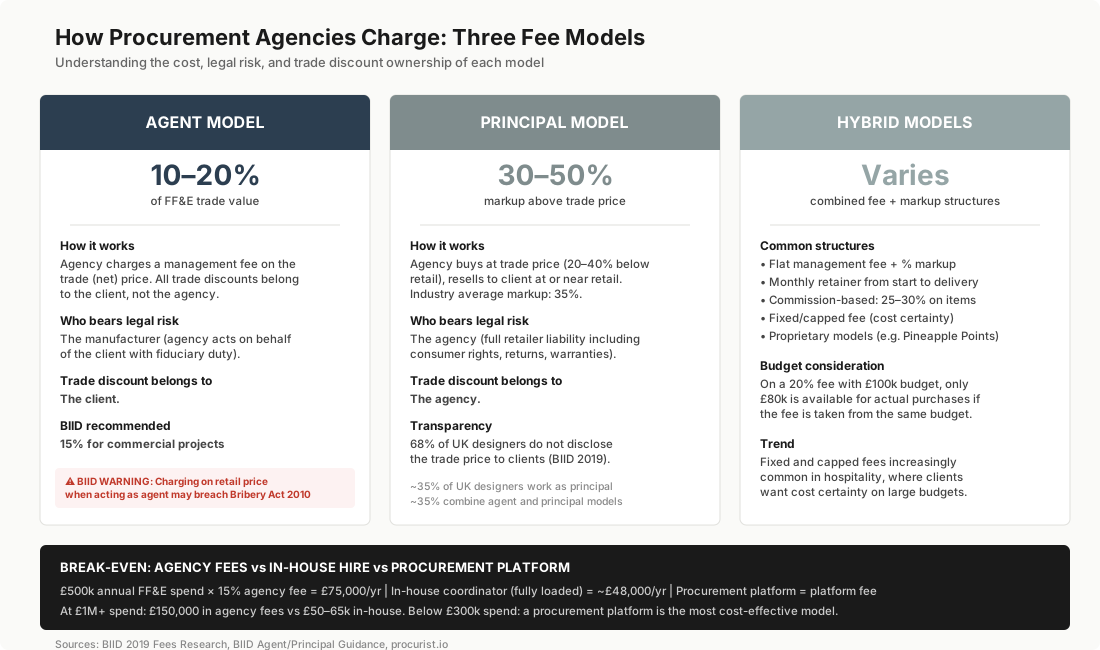
Agent model (procurement fee on trade price). The agency charges a management fee, typically 10–20% of total material costs, and all trade discounts belong to the client. The BIID recommends 15% as the standard administration fee for commercial projects. Under this model, the agency has a fiduciary duty to obtain the best price. Charging a fee on the undiscounted retail price when acting as agent may constitute a breach of the Bribery Act 2010, as the BIID explicitly warns. According to BIID research, approximately 30% of UK designers work as agent.
Principal model (markup on goods). The agency buys at trade price (typically 20–40% below retail) and resells at or near retail, keeping the spread. Industry average markup is around 35%, with a range of 30–50%. The agency takes on full legal responsibility as a retailer. BIID research shows approximately 35% of UK designers work as principal, with another 35% combining both models. 68% do not disclose the trade price to clients.
Hybrid models. Flat management fee plus percentage markup, monthly management fee from project start to delivery, or commission-based structures at around 25–30% on items purchased. Boutique firms like Pineapple Procurement have developed proprietary fee models. Fixed and capped fees are increasingly common in hospitality where clients want cost certainty.
One financial detail often overlooked: on a 20% procurement fee with a budget of £100,000, only £80,000 is available for actual purchases if the fee is taken from the same budget. Agree whether the fee sits within or on top of the FF&E budget at the outset.
Real UK and European examples
London-based:
- • SP3 London handles end-to-end FF&E for private residences, hotels, and restaurants, with OS&E capability
- • TEN London works with 50+ suppliers from 13 countries
- • Chris Turner Procurement is a boutique agency with 25+ years’ experience across the UK, Europe, and Middle East
- • Larkbury London operates from a 10,000 sqm West London facility with 300+ brands and in-house upholstery manufacturing
- • Tollgard runs a design-led commercial procurement division from Chelsea Harbour
- • Woldon provides full procurement with logistics management from Clerkenwell
- • misch_MISCH studio offers full property furnishing for private residences
Outside London:
- • Studio Henderson in Manchester, FF&E procurement and installation
- • Dragonfly Contracts in Manchester, design-build with FF&E and their own installation team
- • Arch Interiors in Glasgow, contract manufacturers across the UK and Europe
- • Qadash, luxury bespoke joinery for hospitality and commercial
Hospitality specialists:
- • OCCA Design, 30 years, independent procurement division separate from design
- • Room Facilities Management in Berkshire, nearly 250 hotel projects across Europe since 2000
- • FEBC Group, offices in London, Dubai, Hong Kong, and Italy, 25+ years across hotels, palaces, and high-end residential
- • Truelux Group, 50+ years combined team experience
- • Atmosphere Creative Interiors, single point-of-contact model
Pros and cons
What works well: Frees you to focus on design rather than chasing orders and managing deliveries. Specialist logistics knowledge, customs experience (particularly post-Brexit), and supplier networks across multiple countries that would take years to build independently. Scalable on a project basis without long-term overhead. Risk transfer for order accuracy, delivery coordination, and damage claims. Better trade pricing through collective volume.
What does not work well: If your business model depends on procurement markup as revenue, outsourcing means sharing or losing that margin. Adding a third party slows communication, and agencies splitting time across clients can delay urgent requests. Your client experience during procurement is handled by someone else, which can dilute your studio’s brand. Fees of 10–20% (or 30–50% markup) add meaningfully to project costs. You lose direct supplier relationships, and rebuilding them later takes time.
The gap for boutique studios
Here is the reality that the agency model does not address well. If you run a studio of 3–15 people, working on residential and high-end commercial projects, sourcing FF&E from European suppliers, you are exactly the type of practice that feels procurement pain most acutely. You have no procurement team, your designers handle sourcing and ordering alongside their design work, and the admin is eating into your margins and your capacity to take on new projects.
But an agency charging 10–20% of your FF&E budget, or marking up goods by 30–50%, may not be justifiable when your annual procurement spend is below £300,000–£400,000. And the overhead of a full-time hire may not be sustainable when your project volume fluctuates.
This is the gap that procurement platforms were built to fill, and it is why we built Procurist. Based on our experience running a design studio, designers can spend up to 250 hours per residential project on procurement work, and almost all of it is operational: searching for products, copying specifications into spreadsheets, building FF&E schedules manually, chasing suppliers for quotes, updating documentation when clients change their minds. Procurist automates that operational layer. You upload your project brief, the platform generates product selections from a curated network of European suppliers, builds and maintains your FF&E schedules, and manages the procurement workflow inside one system. You keep full creative control over every item. The non-creative work is handled by the platform, not by an agency taking a percentage of your budget and not by a designer staying late to update a spreadsheet.
OS&E procurement agencies
OS&E (Operating Supplies and Equipment) procurement is a separate discipline from FF&E, and confusing the two is one of the more expensive mistakes a project team can make. If your work extends into hospitality, yacht, or healthcare interiors, understanding this distinction is not optional.
What OS&E means and why it is different from FF&E
FF&E covers the movable items that furnish and outfit a space: beds, chairs, tables, lighting fixtures, bathroom fittings, televisions, safes, minibars. These are durable assets that contribute to the overall design, require installation, and are expected to last years before replacement.
OS&E covers the consumable and operational items needed for day-to-day operations, and the categories are far more extensive than most designers initially realise: pillows, duvets, mattresses, waste bins, kettles, coffee machines, welcome trays, hangers, hairdryers, sheets, towels, bathrobes, bath mats, cutlery, plates, crockery, glassware, silverware, bar utensils, buffet risers, cleaning cloths, vacuum cleaners, mops, floor machines, linen carts, toiletries, stationery, staff uniforms, office equipment, cooking equipment, laundry equipment. If FF&E is what a guest or crew member interacts with in a space, OS&E is what the space needs to actually function.
You can design the most beautiful hotel lobby in Europe, but without the OS&E procurement in place, there will be no towels in the rooms, no plates in the restaurant, no vacuum cleaners for housekeeping, and no uniforms for the staff on opening day.
The procurement timelines are fundamentally different. FF&E procurement begins early in the project with lead times of 12–26 weeks or more for bespoke items. OS&E procurement starts closer to opening, typically 3–6 months before, with faster lead times but a vastly higher number of individual SKUs. And crucially, OS&E requires ongoing vendor relationships for continuous replenishment, because linens wear out, glassware breaks, and amenities are consumed. OS&E procurement never truly ends.
Why OS&E requires specialist procurement
As Figurz, a European procurement consultancy, notes: “Project teams often realise too late that OS&E is far more complex, technical, and costly than anticipated, which can lead to reductions in initial budgets with potential financial, contractual, and scheduling consequences.”
A single hotel opening can involve thousands of individual line items across every operational department. Robert Dunn, an independent OS&E consultant, creates customised master-lists covering guestrooms, public areas, kitchen, laundry, hotel systems, restaurants, conference rooms, front of house, washrooms, housekeeping, and offices, each with manufacturers, model numbers, par quantities, lead times, unit costs, and total costs.
OS&E procurement also requires operational knowledge that FF&E agents simply do not need: consumption rates, breakage rates, par levels, laundry cycles, brand standards compliance. This is operational expertise, not design expertise. The OS&E budget is frequently the first to be cut when FF&E or construction goes over budget, creating a specialist challenge in value engineering operational supplies without compromising the guest experience or delaying the opening.
OS&E in hospitality
In a hotel project, the OS&E specialist is typically engaged 6–12 months before opening. They build a comprehensive master procurement list covering every item required for the hotel to operate on day one, including par levels for replenishable items. Sourcing happens across specialist hospitality suppliers who understand commercial-grade durability, bulk availability, brand compliance, and rapid replenishment. The “guestroom in a box” concept has emerged, a pre-labelled box system where an entire room’s OS&E setup is reduced to two hours, enabling faster operational readiness.
Logistics coordination is particularly complex because of the sheer number of suppliers involved and the requirement that everything arrives and is set up before opening. Expeditors are commonly assigned to track shipments and provide completion reports.
OS&E in yacht and superyacht design
Superyacht projects are essentially floating hotels with additional layers of complexity. Owner-furnished items include all galley equipment, tableware, glassware, bed linens, towels, crew uniforms, housekeeping supplies, pantry items, laundry equipment, and decorative accessories. Everything must work within extreme space constraints, meet maritime safety requirements, withstand a marine environment, and be delivered to shipyards on tight build schedules with limited access, strict security, and frequently shifting timelines.
Grey’s Interior Consulting, a UK-based superyacht outfitting specialist, works from the initial inventory stage, collaborating with interior designers, owners, and their representatives to select every item from crew uniforms to tableware to decorative accessories. Global Services Ltd, operating since 1995, has supported 45 of the 50 largest yachts built since that date, sourcing from over 9,000 suppliers and processing up to 334,000 items annually across newbuilds ranging from 30m to 180m.
Refit projects add further complexity: existing items must be inventoried, decisions made about what to keep, replace, or upgrade, and new items sourced to match or refresh the existing interior scheme.
OS&E in healthcare
Healthcare facilities require OS&E for patient rooms, clinical spaces, and operational areas, with procurement driven by regulatory compliance, infection control standards, specific durability and washability requirements, and the need for items to integrate with clinical workflows. Interior designers working on healthcare projects typically collaborate with OS&E specialists and medical equipment consultants simultaneously.
How OS&E agencies collaborate with interior designers
The collaboration is complementary. You set the aesthetic direction, specifying the look, feel, material palette, and quality level of every visible item. The OS&E specialist translates that into specific products from specific manufacturers at specific price points, handling durability testing, brand compliance, pricing negotiation, sampling, logistics, and ongoing replenishment.
As SP3 London emphasises, bringing OS&E specialists in early is critical, because discovering at a late stage that specified tableware does not meet brand standards or that the selected linen supplier cannot deliver the volume required for opening creates expensive, time-pressured problems.
Real OS&E specialist agencies
UK-based hospitality:
- • OCCA Design, both FF&E and OS&E, 30 years, global project portfolio
- • Room Facilities Management, Berkshire, nearly 250 hotel projects across Europe
- • SP3 London, OS&E procurement and installation
- • FEBC Group, London, UAE, Hong Kong, Italy, FF&E, OS&E, and pre-opening activation
- • Robert Dunn, independent consultant, customised OS&E master-lists for Hilton, Marriott
- • Procurit Solutions, hotels, hospitality, and catering across multiple continents
Superyacht specialists:
- • Grey’s Interior Consulting, all luxury loose items from inventory stage through delivery
- • Global Services Ltd, 9,000+ suppliers, 334,000 items annually
- • Sea Emporium, founded by Chief Stews, linen, tableware, galley equipment
- • 1855 Superyacht Supply, newbuild and refit with warehouse storage
Fee structures
The hospitality industry has moved toward transparent, fixed-fee models. Benjamin West, described as the world’s leading FF&E and OS&E purchasing firm, acts as a fiduciary agent where their disclosed fee is their sole compensation. Other models include flat fees based on scope, percentage-tiered fees (8% up to £50,000, then 4% above), and cost-savings models where agents reduce overall costs by 10–25% through their supplier relationships. Specific percentages are not publicly disclosed by most agencies.
Internal procurement managers and procurement directors
The alternative to hiring an external agent or agency is employing someone full-time. An in-house procurement manager handles the same operational work but as a permanent member of your team, working across all projects simultaneously, building institutional knowledge that compounds over time, and becoming embedded in your studio’s culture, relationships, and way of working.
What they do day to day
The role sits between the design team and the project management or site team, acting as the operational bridge that ensures what you specify actually arrives on site, on time, in the right colour, at the right price.
On any given day, a procurement manager in an interior design studio is managing multiple workstreams across several concurrent projects: placing purchase orders and tracking production status across dozens of active orders, requesting quotes from multiple suppliers for comparison, preparing tender packages for bespoke items, negotiating prices and payment terms, maintaining cost schedules per project, flagging budget overruns before they become problems, coordinating deliveries with site teams and clients, arranging warehousing when items arrive before the site is ready, inspecting FF&E upon delivery, documenting defects, managing returns and replacements, maintaining the paper trail of invoices, purchase orders, delivery notes, payment schedules, and customs documentation, keeping your material and sample library current, and coordinating installation scheduling with contractors.
Even on smaller projects, a single scheme can involve 1,000+ individual line items. The procurement manager handles the operational weight of all of that across all your active projects simultaneously, which means they can consolidate orders, negotiate better terms based on combined volume, and flag when a supplier issue on one project might affect deliveries on another.
How they integrate with your team
With designers: They review specifications to ensure FF&E orders align with design intent, flag when items are discontinued, over budget, or have unworkable lead times, and propose alternatives. A good procurement manager learns your aesthetic preferences and quality thresholds over time, which means their suggestions improve with each project and require less back-and-forth.
With project managers: They align procurement timelines with construction schedules, coordinate delivery windows with site readiness, and raise early warnings when a supplier delay might cascade into a construction delay.
With finance: They manage purchase orders, track invoices, coordinate payment runs, manage client deposits for FF&E, and provide the data your studio needs for project profitability analysis.
Tools commonly used include Excel and Google Sheets (still universal), specialist software like Studio Designer, EstiMac, DesignSpec, and Fohlio, plus project management tools like Asana or Monday.com for cross-team coordination.
When does it make financial sense?
If you manage £500,000 per year in FF&E spend through an external agency charging 15%, that is £75,000 in agency fees. A mid-level procurement coordinator at £40,000 salary (approximately £48,000 fully loaded) saves approximately £27,000 per year. At £1 million or more, the savings are substantial: £150,000 in agency fees versus £50,000–£65,000 for a dedicated hire.
The threshold where most studios consider a dedicated hire is around 12+ staff or 3–5 concurrent projects, according to Design Manager, which notes that “in a firm with twelve designers or more, specialised roles become necessary.” The first hire is often a hybrid role combining procurement with studio management before splitting as the firm grows.
Where agencies still win even at scale: studios with irregular project flow where a salary during quiet months is a burden, one-off projects requiring specialist expertise your team lacks, and projects in geographic markets where you have no supplier network.
UK salary ranges
Based on Hunter Dunning, HAUS Careers, and industry surveys:
| Role | UK range | London premium |
|---|---|---|
| Junior FF&E Procurement Coordinator | £22,000–£28,000 | £25,000–£30,000 |
| FF&E Procurement Coordinator (2–3 years) | £30,000–£40,000 | £35,000–£45,000 |
| Procurement Specialist / Senior Coordinator | £38,000–£48,000 | £42,000–£55,000 |
| Procurement Manager | £45,000–£55,000 | £50,000–£60,000 |
| Head of Procurement / Senior Manager | £55,000–£70,000+ | £60,000–£78,000+ |
Interior design sector roles pay below cross-sector averages because of smaller company sizes and lower spend volumes compared to manufacturing or pharmaceuticals.
Pros and cons
What works well: Deep knowledge of your brand, standards, and suppliers that compounds with every project. Full-time availability with no third-party delays. Consolidated volume discounts across all your projects. Cost-effective at scale. Stronger accountability as an embedded team member. Supplier relationships that belong to the studio.
What does not work well: Fixed overhead regardless of project volume. Limited to one person’s network and expertise. Single point of failure if they leave, with institutional knowledge walking out the door (recruitment and onboarding takes 2–3 months). May lack specialist knowledge for unusual categories or unfamiliar markets. Requires management, training, workspace, and tools. A junior hire saves money but needs significant supervision, a senior hire delivers independence but at a cost that may not suit moderate procurement volumes.
Procurement platforms: the alternative to agencies and manual workflows
Every procurement model described above, whether brand reps, agencies, or in-house managers, still relies on the same manual infrastructure that has defined this industry for decades. You are still building FF&E schedules in spreadsheets, still managing supplier communication through email threads and WhatsApp messages, still searching for products across dozens of separate supplier websites, still copying product data between documents manually, still updating schedules by hand every time a client changes a finish or a supplier discontinues a product.
The question this article has been building toward is not just who should handle your procurement, it is how the work itself gets done.
What procurement platforms do
Procurement platforms automate the operational layer of procurement through software, handling the non-creative tasks that consume your time without requiring an external person or agency fee. Rather than paying someone 10–20% of your FF&E budget to manage a process that is still fundamentally manual, a procurement platform digitises the process itself.
This means automated sourcing suggestions matched to your project brief, FF&E schedules that build and update themselves as you specify products, supplier coordination and order management inside one system rather than across email threads and spreadsheets, centralised product information that does not need to be manually copied between documents, and a workflow that moves with your project rather than requiring you to maintain a parallel administrative infrastructure alongside it.
Why this matters for boutique studios
If you run a studio of 3–15 people, working on residential and high-end commercial projects, and you are handling procurement yourselves because you cannot justify agency fees or a full-time hire, you are the exact designer this model was built for. You are too small for an agency to be cost-effective, too busy to keep managing procurement through manual processes, and too design-focused to want procurement administration to be the thing that defines your working week.
Procurement platforms sit in the gap between “doing it all yourself with spreadsheets” and “paying an agency 10–20% of your budget to do it for you.”
Procurist
Procurist was built by an interior designer who spent one too many late nights in the studio finishing a revised FF&E presentation after spending all day chasing after suppliers. It is a full procurement platform for interior designers that handles sourcing, specifications, FF&E schedules, supplier coordination, and order management inside one system, connected to a curated network of vetted European manufacturers and brands, including trade-only suppliers not easily accessible through conventional channels.
You upload your project brief, the platform generates product selections, you retain full creative control over every item, and the operational layer, the part that we know from running our own studio can consume up to 250 hours per residential project, is handled by the platform. You can source products from anywhere and curate your own private product library by pasting any link, which automatically organises and saves product data and images. You can link your existing trade contacts, so the platform works with your supplier relationships rather than replacing them. And you can delegate additional sourcing and procurement tasks directly to the Procurist team through the concierge feature from anywhere in your workflow.
The difference between a procurement platform and a procurement agency is not just cost, it is control. An agency takes over your procurement process and runs it their way, with their suppliers, on their timeline, at their fee. A platform gives you the infrastructure to run procurement efficiently yourself, with your suppliers, your creative decisions, and your client relationships intact.
If you are spending more hours on procurement administration than on design, see how Procurist works.
How procurement agents and agencies save interior designers time and money
The case for delegating procurement, whether to a person or a platform, is not abstract, it is measurable. Interior design studios of 2–10 people waste an estimated 12–15 hours per week on administrative tasks that could be automated or delegated, and procurement accounts for a significant portion of that time.
Time
Procurement work in a design studio is dozens of small tasks repeated across every product on every project: searching for products, requesting quotes, chasing supplier replies, comparing options, copying product information into spreadsheets, building and updating FF&E schedules manually, coordinating orders, tracking deliveries, managing returns. A 2025 Houzz survey of 700+ professionals found that designers using automation tools save 3+ hours per week on administrative tasks alone, translating to approximately £75,000–£108,000 in annual productivity gains per business. The average small studio owner spends 36% of their time on admin, and most firms struggle to achieve even 60% billable utilisation against a target of 75–85%.
Delegating procurement returns that time to the work that generates revenue and differentiates the studio: design.
Money
Procurement agents and agencies negotiate better trade pricing than most individual studios can achieve alone. Trade discounts for established agencies can reach 40–60% off retail, versus the 10–20% newer or smaller studios typically access. Experienced procurement professionals also reduce costs by catching specification errors before orders are placed, consolidating shipments to reduce freight costs, identifying cost-effective alternatives that meet the design intent, and managing claims efficiently when goods arrive damaged or incorrect.
Procurement platforms offer a different cost advantage: they do not take a percentage of your FF&E budget. The operational savings come from automation rather than outsourcing, which means the studio retains the full benefit of its trade pricing without sharing margin with an intermediary.
Risk reduction
The median perfect order rate across industries is only 90%, meaning one in ten orders has some error. In furniture specifically, up to 6% of deliveries result in property damage, and items are typically handled 6–8 times between factory and site. When a fabric is discontinued between specification and ordering, you are not just replacing a product, you are recalculating budgets, potentially redesigning a room, and communicating the change to every stakeholder. A dedicated procurement professional or a well-structured platform reduces this risk through established processes, proactive timeline management, and the systems to anticipate problems before they become expensive.
What you do with the time you recover
Studios that successfully delegate procurement take on more projects, deepen client relationships, invest in business development, and expand into new revenue streams. Increasing billable time from 50% to 60% is a 20% revenue increase without raising rates. For a studio billing £200,000 a year, that is £40,000 in additional revenue from time that was previously consumed by chasing purchase orders.
The less quantifiable benefit is creative energy. When procurement admin consumes the majority of your week, the actual design work gets compressed into whatever hours remain. Hannah Bowyer, an interior design business consultant, describes the pattern: “When admin tasks start to take centre stage, the creative, fulfilling, soul-sparking part of interior design gets pushed to the sidelines.” Delegating procurement does not just free up hours, it restores the capacity for focused creative thinking that produces distinctive work and justifies premium fees.
How to choose the right procurement model for your studio
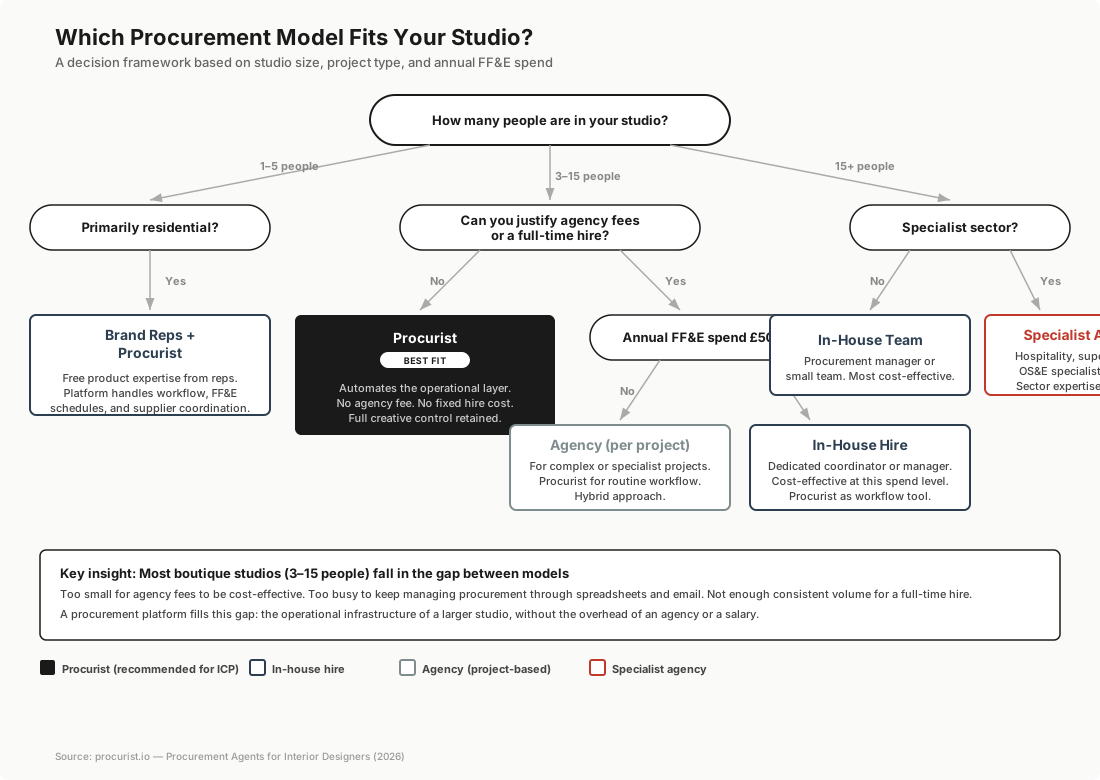
There is no universally correct procurement model. The right choice depends on your project type, studio size, annual procurement volume, and in-house capacity.
A decision framework
If you are a small studio (1–5 people) with primarily residential projects and domestic suppliers: Brand reps are your most cost-effective external resource for the brands you specify frequently. For the procurement workflow itself, a procurement platform like Procurist handles sourcing, FF&E schedules, and supplier coordination without the cost of an agency or a hire, giving you the infrastructure of a larger studio without the overhead.
If you are a boutique studio (3–15 people) handling procurement yourselves because you cannot justify an agency or a full-time hire: This is the profile Procurist was built for. You feel procurement pain directly in your project timelines, your margins, and your capacity. A procurement platform automates the operational layer so you can manage procurement efficiently without hiring, without outsourcing, and without spreadsheets.
If you are a mid-sized studio (5–15 people) with growing project volume or increasingly complex projects: You are at the inflection point. You are either hiring a dedicated procurement coordinator (if annual FF&E spend exceeds £300k–£500k and the workload is consistent) or engaging an agency for larger projects while using a procurement platform for routine work. Many studios at this size use a hybrid: platform for day-to-day workflow, agency for specific projects that exceed internal capacity.
If you are taking on hospitality, superyacht, or large commercial projects for the first time: Hire an agency with sector-specific expertise. The logistics, compliance requirements, and volume are categorically different from residential work, and learning on the job will cost more than the agency fee.
If you are an established studio with £1M+ annual FF&E spend: An in-house procurement manager or small team almost certainly costs less than agency fees at this volume. You might still use a procurement platform as workflow infrastructure and engage agencies for specialist projects.
Questions to ask before hiring an agency or rep
- • What is their fee structure, and is it agent, principal, or hybrid? Understand whether trade discounts belong to you or to them, and whether the fee sits within or on top of the FF&E budget.
- • Do they have demonstrable experience in your specific project type and geographic market?
- • How many concurrent projects are they managing, and what is the realistic turnaround time for quotes and updates?
- • Will they work with your existing suppliers, or only their own network?
- • What happens when something goes wrong? Who manages damage claims, incorrect orders, and delivery delays?
- • What is their quality control process?
- • Can they provide references from studios of a similar size and project type?
Red flags to watch for
- • An agency that cannot clearly explain their fee structure or resists putting terms in writing
- • Pressure to use only the agency’s preferred suppliers, which may indicate undisclosed commissions
- • No established quality control process for inspecting goods before delivery
- • Limited or no experience in your specific sector, presented with vague assurances
- • Charging a procurement fee on retail price rather than trade price when acting as agent, which the BIID notes may raise legal concerns under UK bribery legislation
- • An inability to provide references from comparable projects
Frequently asked questions
What does a procurement agent do in interior design?
A procurement agent handles the operational side of sourcing, purchasing, and delivering FF&E for interior design projects. This includes sourcing from supplier networks, negotiating trade pricing, placing and tracking orders, coordinating logistics and international shipping, inspecting goods, managing damage claims, and coordinating delivery and installation. The agent takes over administrative procurement work so you can focus on design. Depending on the type, they may represent specific brands (brand reps), manage entire project procurement (agencies), handle operational supplies for hospitality and marine projects (OS&E specialists), or automate the workflow through software (procurement platforms like Procurist).
How much do procurement agents charge interior designers?
Fee structures vary by model. Agencies acting as agent charge 10–20% of FF&E trade value as a management fee, with all trade discounts belonging to the client. Agencies acting as principal buy at trade (20–40% below retail) and resell at a markup of 30–50%. Brand representatives cost you nothing directly, earning 7–15% commission from manufacturers. Procurement platforms operate on subscription or transaction-based models rather than taking a percentage of your FF&E budget. The BIID recommends 15% as the standard administration fee for commercial projects when working as agent.
What is the difference between FF&E and OS&E procurement?
FF&E (Furniture, Fixtures, and Equipment) covers durable, movable items that furnish a space: furniture, lighting, bathroom fittings, artwork. OS&E (Operating Supplies and Equipment) covers consumable and operational items for day-to-day operations: linen, towels, tableware, cleaning equipment, uniforms, toiletries, kitchen equipment. FF&E procurement begins early in a project with long lead times. OS&E starts closer to opening (3–6 months before), involves far more individual items, and requires ongoing replenishment. The distinction matters most in hospitality and superyacht projects.
Do I need a procurement agent for residential projects?
Not necessarily. For smaller residential projects with domestic suppliers, many studios handle procurement with support from brand reps and a procurement platform. A procurement agency becomes valuable when the FF&E budget is large (£250k+), sourcing is international with multiple European suppliers, items are predominantly bespoke with long lead times, or the studio lacks bandwidth. For boutique studios doing residential work, a procurement platform often provides the right balance: the operational infrastructure without the agency cost.
When should an interior design studio hire an in-house procurement manager?
The tipping point is around 12+ staff, 3–5 concurrent projects, or annual FF&E spend exceeding £500,000. At this volume, an in-house hire (£35,000–£55,000 salary, approximately £42,000–£66,000 fully loaded) costs less than agency fees on the same spend. Many studios start with a hybrid role combining procurement with studio management before splitting into dedicated positions. Below this threshold, a procurement platform can provide the workflow structure without the fixed overhead.
Can I use a procurement agent and keep my own supplier relationships?
Yes, and you should clarify this before engaging any agency. Most independent agencies will work with your existing suppliers alongside their own network. Some agencies prefer to work exclusively through their own vendor relationships, which can mean losing direct contact with suppliers you have built over years. If maintaining your own relationships is important, make this non-negotiable. Procurement platforms like Procurist are designed to work with your existing suppliers, you can link your trade contacts and import your own products while accessing the platform’s curated supplier network alongside them.
What is the difference between a brand representative and a procurement agency?
A brand rep works for the manufacturer and promotes a specific portfolio of brands within a defined territory. They earn 7–15% commission from the brands they represent and cost you nothing directly. Their expertise is product-specific. A procurement agency works for you and manages the entire procurement process across any supplier. They charge 10–20% management fees or 30–50% markup. Their expertise is process-specific. Brand reps are product specialists with an inherent bias toward the brands that pay them. Procurement agencies are process specialists who should recommend the best option regardless of brand. A procurement platform automates the process while letting you make the product decisions.
How do procurement agents handle damaged or incorrect orders?
Established agencies have formal claims management processes. When goods arrive damaged or incorrect (up to 6% of furniture deliveries, with items handled 6–8 times between factory and site), the agent documents the issue, files claims with the supplier or shipping company, arranges replacements, and manages the timeline impact. They communicate the situation to all stakeholders, propose solutions, and follow the claim through to resolution. This is one of the most time-consuming aspects of procurement for studios handling it in-house, and one of the clearest areas where either an agent or a structured procurement workflow adds value.
Are procurement agents worth it for small interior design studios?
Brand reps are free and valuable at any studio size for the brands they carry, though small studios may find reps less responsive. Full-service agencies at 10–20% of FF&E value may not be justified below £300,000 annual spend. For small studios, the most cost-effective approach is strong brand rep relationships, a procurement platform to manage the operational workflow, and a studio manager handling day-to-day coordination. The exception is a project that exceeds internal capacity, where engaging an agency for that specific project makes financial sense.
What should I look for when choosing an FF&E procurement agency in the UK?
Look for agencies with experience in your project type, transparent fee structures documenting whether they act as agent or principal, quality control processes with inspection at multiple stages, and references from studios of your size. Ask how they handle damage claims, whether they will work with your existing suppliers, how many concurrent projects they manage, and what their realistic turnaround times are. The BIID’s guidance on supplying FF&E as agent or principal is essential reading, particularly around the legal distinction between models and Bribery Act implications.
Written and Published by Procurist