
On most interior design proposals the design fee is on one page and the furniture is on another, and nobody explains how the two are connected. They are connected, and the connection is not a secret inside the industry.
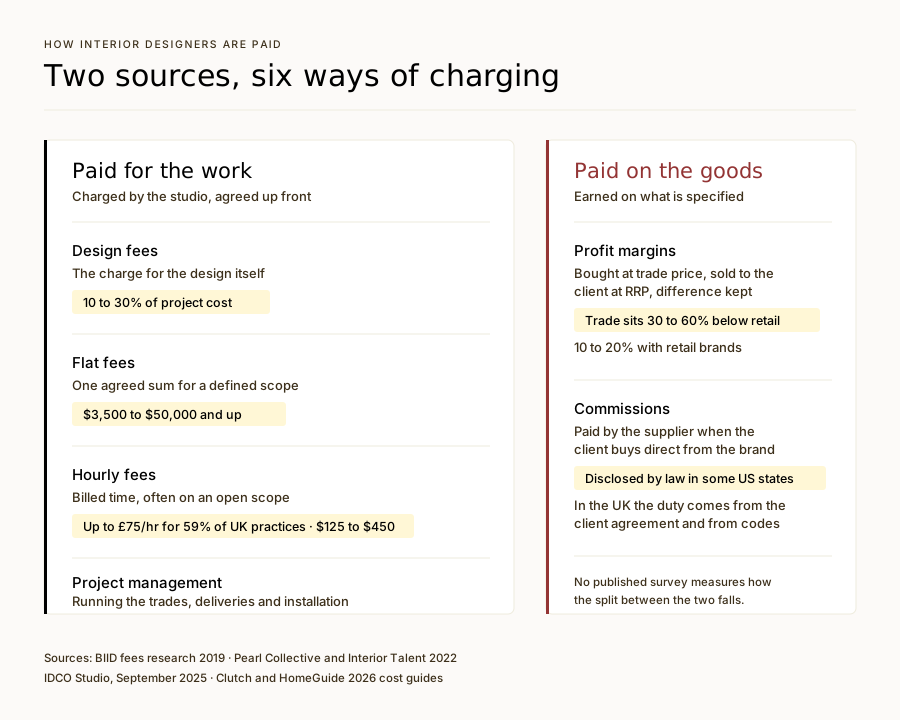
Interior designers are paid from two places. The first is a fee for the work, charged hourly, as a fixed sum, or as a percentage of the project. The second is the goods. Where you buy directly from a brand, your designer may be paid a commission by that supplier, and in several jurisdictions they are legally required to tell you. Where your designer buys the piece and sells it to you, they are the merchant, they pay the trade price and you pay the recommended retail price, and the difference between the two is theirs.
Key takeaways
- No single fee model is standard. In the BIID’s 2019 fees research, 51 percent of respondents used a combination of charges, 21 percent a fixed fee, 18 percent an hourly rate and 6 percent a percentage of project cost.
- Commission and margin are different things with different rules. Commission is paid to your designer by a supplier. Margin is the difference between the trade price your designer pays and the retail price you pay.
- Where you buy direct, Florida and Texas require disclosure in statute and the UK relies on the BIID code. Where your designer resells, no statute caps the price and none imposes a disclosure duty, because you are buying from your designer.
- On IDCO Studio's September 2025 figures, trade pricing runs roughly 10 to 20 percent below retail with national retail brands and 30 to 60 percent below with trade manufacturers.
- A designer charging you RRP is charging you the same price the piece publicly sells for.
- Procurement has historically run to 250 hours per residential project, on the Interior Design Community's survey. The trade applications, the quote chasing and the schedule rebuilds have moved into software.
Why nobody can tell you what an interior designer’s fee should be
There is a lot of secrecy and lack of transparency when it comes to how interior designers make money. Not just between designers and their clients but also industry-wide, and there is no universal business model or fee breakdown, and obviously every project depends on the scope etc. too.
The four ways designers charge
Interior designers charge in four common ways: an hourly rate, a fixed fee for a defined scope, a percentage of the total project cost, or cost-plus, where the client pays what the designer paid for an item plus an agreed percentage. Two proposals are rarely structured the same way.
No single fee model has a majority
The professional bodies collect the evidence for this themselves. In the British Institute of Interior Design’s 2019 fees research, 51 percent of respondents used a combination of charging methods, 21 percent used a fixed fee, 18 percent an hourly rate, 6 percent a percentage of total project costs and 4 percent something else again. The largest group was the one that mixed several together.
A 2022 survey of more than 900 interior design firm owners, run by Pearl Collective and Interior Talent, found much the same picture from the American side, with 80 percent of firms charging hourly or hourly-plus-markup and 40 percent using fixed fees, often alongside the hourly rate rather than instead of it. Writing in the Interior Design Community in April 2026, Laurie Laizure put it plainly, that on procurement fees there is “no universal right answer”.
For ranges, the commercial cost guides are the only current source, and they should be read as ranges rather than research. Clutch’s August 2026 pricing guide and HomeGuide’s 2026 cost guide put hourly rates between 125 and 450 dollars, flat project fees between 3,500 and 50,000 dollars and up, percentage fees at 10 to 30 percent of project cost, and cost-plus markups on furniture at 15 to 35 percent. The BIID’s own 2019 figures put the most senior designer in the practice at up to 75 pounds an hour for 59 percent of respondents and between 76 and 150 pounds for the other 41 percent.
Why two quotes are never the same number
The reason the numbers refuse to line up is scope. A fee that covers concept, drawings, specification, sourcing, ordering, delivery coordination and installation is not the same product as a fee that covers concept and drawings and hands you a shopping list.
The two places a designer’s money actually comes from
However, most commonly a designer’s revenue comes from a combination of service fees and commissions or profits on goods sourced and procured for the project on behalf of their client. Whilst many countries or states have specific laws around disclosing commissions to their clients if they get their clients to purchase directly from brands and manufacturers, though these are often ignored too but that’s a different issue, there are no rules for how much designers get to mark up products if they resell those products and thus become the official merchant or vendor.
Which of those two applies to you is decided by who you pay. If you pay the brand, your designer may be earning a commission from that brand and in several places is required to tell you. If you pay your designer, your designer bought the piece at trade and sold it to you, and what they earn is the margin between the two prices. Three words get used for that money and they mean different things.
- Commission is money paid to your designer by the supplier. You buy the sofa from the brand, the brand pays your designer a percentage. Your designer is acting as an introducer.
- Markup is an amount added on top of a price you have been shown. If a piece is presented to you at 4,000 pounds plus 20 percent, that 20 percent is a markup.
- Margin is the gap between the trade price your designer pays and the retail price you pay. Nothing is added on top.
Agent, or seller
Underneath those three words sits one distinction that decides which of them applies. Either your designer is acting as your agent, or your designer is the seller.
Your designer is your agent only where your written agreement says so and the supplier invoices you directly. Otherwise the pieces are bought in the studio’s name and sold on to you, which makes the studio the seller.
What the rules actually say about commission
Where you buy directly from a supplier, several US states legally require your designer to disclose what that supplier pays them, and in the UK the duty comes from your written agreement and from professional codes rather than from statute. Where your designer buys the piece and resells it to you, no jurisdiction caps the price and none imposes a disclosure duty, because you are buying from your designer rather than through them.
Where it is written into law
Florida requires disclosure in statute. Under F.S. 481.2131(2), “The interior designer shall have the responsibility of fully disclosing to the client the manner in which all compensation is to be paid. Unless the client knows and agrees, the interior designer shall not accept any form of compensation from a supplier of goods and services in cash or in kind.”
Texas takes the same position through its board rules.
22 TAC section 5.155(b) forbids a registered interior designer from accepting “any financial or other valuable consideration, material favor, or other benefit of any substantial nature, financial or otherwise, from more than one party in connection with a single project or assignment unless the circumstances are fully disclosed in writing to all parties.”
The United Kingdom position
In the United Kingdom there is no interior design statute. The BIID Code of Conduct, effective 1 April 2026, requires under clause 2(c)(iii) that a member “must not accept payments or benefits which may (or could reasonably be perceived to) impair your ability to remain impartial and transparent on behalf of clients”, and the obligation reaches your project through your contract with the studio rather than through a regulator.
Why there is no rule on resale
On the resale side there is no equivalent rule anywhere, for the same reason no disclosure duty attaches to a shop. What governs it instead is your written agreement. In Johnson v Robert Shields Interiors (E.D. Va. 2016) a court awarded a client damages under the Virginia Consumer Protection Act over furniture markups that had not been disclosed to her. The margin itself was not the problem, the contract was.
Is that fair?
Is this fair? Honestly yes. And for many design studios those profit margins account for the majority of their business revenue, as design fees often don’t even cover their business costs. Again, this heavily depends on the individual firm, their scope and type of clients, but especially in most of Europe where overall willingness to spend on services is lower, this is often the case.
What a design fee is actually carrying
What a design fee is buying is easy to underestimate from the outside, because the visible part of the work is the smallest part of it. The fee carries studio overhead, salaried junior time, the revisions for the revisions, and the hours spent on the scheme that was rejected.
The BIID’s own pricing guidance describes a fixed fee as the designer working out how long the project will take and what overheads are involved, then producing a figure from both. The 2022 Pearl Collective survey found firms undercharging their fixed fees by roughly 50 percent.
What the margin covers that the fee does not
The margin does more than top up the fee. Writing in the Interior Design Community in April 2026, Laurie Laizure describes markup as funding financial risk, because the studio is “often fronting payments, managing deposits, and absorbing the labor of handling returns”. Your designer pays the deposit on a piece months before you see it, and carries the loss if it arrives wrong.
Does margin push a designer toward expensive pieces?
They are, and the control for it is the written agreement, which is what the Virginia case turned on.
A designer working to an agreed furniture budget, with the pricing basis stated in the contract, is not free to inflate the scheme. That budget is the document to read closely, rather than the fee line.
What you are actually buying access to
Experienced interior designers have access to a whole different network of manufacturers and brands who don’t even sell direct to consumer, so not only does purchasing through your designer make the project run more smoothly and mean clients don’t have to deal with the stress of procurement etc. but they also get access to a way better quality and value than buying from big box retailers or direct to consumer resellers.
Trade-only manufacturers sell to registered design businesses and nobody else, they publish no consumer prices, and they do not operate a checkout. There is no version of that account a private buyer can open.
What trade-only actually means
A workshop producing to order has no reason to build a consumer channel and no capacity to serve one. The account that lets your designer order at all was applied for and approved brand by brand, which is how trade programmes work across the industry, as IDCO Studio’s guide to trade accounts sets out. Heritage manufacturers running generational family production, small artisan studios, specialist makers working in one material, none of them are reachable by a member of the public with a credit card.
What procurement contains once the piece is chosen
The work your designer absorbs is more concrete than it sounds. On our furniture lead time guide, custom pieces run 8 to 16 weeks domestically and 12 to 24 weeks or more for European imports.
Deposits are usually taken before production starts, and freight is booked and consolidated separately. For UK clients buying EU-made goods, post-Brexit import documentation and duties add another one to two weeks of clearance, longer when a form is wrong.
Does buying through your designer cost you more?
Is it a ripoff? No, because good designers usually charge RRP to their clients anyway, meaning the clients get at least the same price they could get anywhere else but with a way better service and advice.
RRP is the recommended retail price, the published price the piece sells for, and where the brand sells publicly you can check it yourself. Designers who work this way tend to say so in the contract.
A £5,000 piece, both ways
Take a piece from a trade-only manufacturer with an RRP of 5,000 pounds, where your designer’s trade price is 40 percent below retail, in the middle of the usual range. Your designer pays 3,000 pounds for it. You are invoiced 5,000 pounds, the same 5,000 pounds you would have paid buying it yourself, assuming you could have bought it at all. The 2,000 pounds is your designer’s margin, and it did not come out of your budget, it came out of the trade discount the brand gives to the trade.
What the trade discounts actually are
Those discounts are documented. IDCO Studio’s trade accounts guide, updated September 2025, puts national retail vendors at “around 10-20% off retail pricing” and trade manufacturers at “anywhere from 30-60% off retail pricing”, and notes that some designers “sell the pieces to their clients at retail price (MSRP) and keep the discounted difference as a commission”. The deepest discounts sit with independent European manufacturers who have no retail presence of their own.
Buying through your designer, and buying it yourself
| Buying through your designer | Buying it yourself | |
|---|---|---|
| Price you pay | RRP | RRP, where the piece is sold publicly at all |
| Access to trade-only makers | Yes | No |
| Who places, tracks and chases the order | Your designer | You |
| Who handles a damaged or late delivery | Your designer, with the vendor | You, with the vendor |
| Customs and duty on an EU-made piece | Your designer | Yours to file |
What separates a designer with real access from one without
Things to watch out for: your designer should understand where the items they specify come from and be able to offer you access to things you can’t find on Google. The best designers are adapting quickly to the technological advancement and changes in supply chain and should be on top of everything.
Two tests tell you whether a designer holds real supply access. The first is whether they can name who makes each piece they have specified, rather than who distributes it. The second is whether you could have found those pieces yourself.
Knowing where a piece comes from
A designer who knows who actually makes a piece, rather than who distributes it, knows whether a lead time is a real date or a hopeful one. There is also a relationship to call on when something slips.
A studio that specifies through a reseller inherits that reseller’s delays.
Could you have found these pieces yourself?
If every item on your schedule is orderable online this afternoon, what you have paid for is curation and taste. That is worth paying for. It is not access. Access looks like pieces you could not have found, from makers you had not heard of, at prices you have no way of independently beating.
Why procurement should not be billed to you by the hour
Whilst sourcing and procurement traditionally did take hundreds of hours, manual processes and in person trade appointments, this has shifted dramatically as platforms like Procurist offer designers the same and better access but automate the in-between. The best designers use this to offer better services to their clients and be able to focus more on design and increase their margins as their labour cost of sourcing and procurement is reducing to zero.
Sourcing and procurement have historically been the most time-consuming part of running a residential project, and according to a survey by the Interior Design Community, designers spend up to 250 hours of procurement work per residential project, almost none of it design. Most of that work is now automated.
What the work actually was
Every brand your designer wants to specify from needs its own trade application, approved or not on that brand’s own timetable. Quotes are requested one at a time and chased. The schedule is rebuilt from scratch each time you change your mind about one chair, which on the Interior Design Community’s figures runs to 15 to 25 hours per project on schedule creation and revisions alone.
What it costs now
None of that is design, and most of it no longer needs a person. Where a studio runs its procurement on a platform, it pays a fixed monthly subscription for it, from 189 euros a month on Procurist. That is a cost of running the studio, not an hourly charge that lands on your project.
Three things worth asking before you sign
Three things on a proposal tell you how your designer sources: a separate charge for procurement, a price above RRP, and big-box retail on the schedule. Each has a reasonable explanation and each is worth hearing before you agree to anything, because between them they tell you whether the studio is buying at trade from makers you cannot reach.
A separate charge for procurement
Billed hours, a percentage, or a line called procurement management. Ask what it covers. Some of it is real and always will be: the deposits fronted, the returns handled, the risk carried. The applications, the quote chasing and the manual schedule rebuilds have moved into software, and a fixed monthly subscription is not something a project pays for by the hour.
A price above RRP
Ask what pricing basis the contract uses, and check two or three items against the brand’s own published price. A designer buying at trade and selling at RRP is already earning on the piece. A markup added on top of RRP is a second charge on the same item, and no statute requires it to be disclosed.
Big-box retail on the schedule
Ask where each piece is made and who makes it. A schedule built from what is orderable online is the clearest signal that the studio is sourcing from the same places you would.
Written and Published by Procurist
Frequently asked questions
Do interior designers get commission on furniture?
Some do. Where you buy directly from a brand or manufacturer, that supplier may pay your designer a commission on the sale. Where your designer buys the piece and invoices you for it, there is no commission, because your designer is the seller and earns the difference between the trade price they paid and the retail price you pay.
Do interior designers have to tell you if they receive commission?
In several US states, yes. Florida statute 481.2131(2) requires full disclosure of how all compensation is paid and forbids accepting supplier compensation unless the client knows and agrees. Texas rule 22 TAC 5.155(b) requires written disclosure to all parties before accepting payment from more than one party on a project. In the UK there is no interior design statute, and the duty comes from your contract and from professional codes such as the BIID’s.
How much do interior designers mark up furniture?
Cost-plus markups are quoted at 15 to 35 percent in the 2026 Clutch and HomeGuide cost guides. Many designers do not mark up at all in that sense, and instead buy at trade and sell to you at the recommended retail price, keeping the difference. Trade discounts run around 10 to 20 percent off retail with national retail brands and 30 to 60 percent with trade manufacturers, on IDCO Studio’s September 2025 figures.
Can I get trade pricing without an interior designer?
No. Trade accounts are opened brand by brand, on approval, for businesses that buy regularly and specify professionally, and many of the best European manufacturers have no consumer channel at all. There is no version of the account a private client can open, which is why access rather than discount is the thing a designer actually holds.
Is furniture cheaper if I buy it myself?
Usually not. A designer charging RRP invoices you the same published price you would pay buying it yourself, so the cost is identical and the service is not. Where a piece is only sold to the trade, there is no self-purchase price to compare against, because you cannot buy it.
Should I buy furniture through my interior designer?
For most projects, yes, provided the pricing basis is written into your agreement. Buying through your designer gives you access to makers with no consumer channel, one party responsible for orders, deliveries, damage claims and customs, and a schedule that arrives in installation order. Ask what pricing basis they use, and check a few items against published prices.
What is cost-plus pricing in interior design?
Cost-plus means your designer shows you what they paid for an item and adds an agreed percentage on top, so you see both numbers. It is the opposite of buying at trade and selling at RRP, where you see one number, the published retail price, and the designer’s earnings sit inside it. Both are legitimate, what matters is which one your contract names.
How long does sourcing and procurement take an interior designer?
Historically, up to 250 hours per residential project, according to a survey by the Interior Design Community, covering sourcing, quote chasing, schedule building, delivery coordination and customs documentation, with 15 to 25 hours of that going on FF&E schedule creation and revisions alone. Lead times themselves have not shortened, at 8 to 16 weeks for domestic custom pieces and 12 to 24 weeks or more for European imports, but the administrative work around them has largely moved into software.